Monday, April 20, 2015
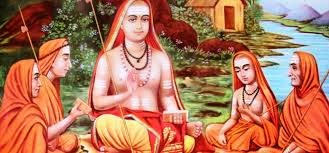
The Advent Of Aadi Shankara
The advent of Adi Sankara is a landmark event in the history of Indian philosophy and religion and in the personal spiritual progress of every individual. His teachings reveal the truth of the Supreme Brahman to the sincere seeker. In a lecture, Sri R. Krishnamurthy Sastrigal drew attention to a verse in the Madhaviya Sankara Vijayam, a biographical work on Adi Sankara, wherein the poet compares the effort of Adi Sankara with that of Hanuman in the matter of spiritual realisation. It states that Adi Sankara fought and tore asunder the demon Avidya or ignorance that had swallowed Brahma Tatva to reveal the Supreme Truth to humanity even as Hanuman fought with demons and evil forces during his mission to search for Sita who stands for Jiva Tatva or Maya Shakti. Sita forgets her true nature and longs for the golden deer. She is thus separated from Rama, her true moorings and is caught in the vicious atmosphere in Ravana’s Lanka. The Jiva Tatva is enveloped in the evil forces of Samsara such as desire (kama), anger (krodha), greed (lobha), delusion (Moha), pride (mada) envy (matsarya) etc, that prevent the atma’s union with the Brahman. Hanuman brings the tidings of the whereabouts of Sita to Rama, and enables the union of the Jiva with the Brahman.
Adi Sankara sought to relieve mankind from all the miseries that affect one and all. There are three kinds of miseries that human beings have to suffer in this world. In spiritual parlance these are described as Adyatmika, Adi Daivika and Adi Bhoutika. Adyatmika refers to the relation between the individual self and the Supreme Self. It is based on the truth that the individual self is a manifestation of the Supreme spirit. Adi Daivika refers to the miseries caused by fate and Adi Bhoutika to those sorrows caused by the material world and body. Adi Sankara’s effort is a cut above for, this acharya destroyed the rakshasa Avidya that is the root cause of all sorrow. Removal of ignorance results in self realisation which is the ultimate goal of the Jiva.
Wednesday, February 25, 2015
Movie On Swamy Chimayananda
A two-hour English documentary, ‘On A Quest’ chronicles Swami Chinmayananda’s remarkable journey from the inquisitive child Balan to a rebellious youth, a revolutionary freedom fighter and a daring atheist to his transformation into the missionary saint Swami Chinmayananda.
Who says commercial films starring superstars like Rajnikanth or Shahrukh Khan alone can have punch lines?
Sample this: “India is free, but are Indians free?”; “God is like the petrol in a car. Without the petrol, the car cannot run. But it is the driver who determines where the car goes.”; “Without the touch of life (read God), a sinner cannot sin neither can a monk meditate".
These are powerful words not penned by any scriptwriter but uttered by men of high knowledge and wisdom that appeal equally to the atheist and the divine. Many more such meaningful dialogues generated applauds, evoked emotions and accentuated the wow factor of ‘On a Quest’ -- a period film on Swami Chinmayananda’s journey from a freedom fighter and a non-believer to a teacher of Vedanta.
The two hour biopic in English was screened for the second time on popular demand in Madurai and the people who filled up the Mookambika theatre on Sunday morning got their money’s worth.
Made by the Chinmaya Mission to mark the birth centenary celebrations of Swami Chinmayananda, this is the first ever documentation of the fiery young revolutionary’s transformation into a missionary. It is a beautifully woven and enacted story which unlike the stories about most other gurus, does not push Swami Chinmayananda’s lectures, achievements or books to the forefront.
Rather, director R.S.Prasanna of “Kalyana Samayal Saadham" fame convincingly and touchingly tells the story of a man who never made claims of being a god or a godman and offered miracles. He simply interpreted the Bhagavad Gita for the masses. No matter, if there weren’t enough people to listen to him or even if the most educated came to him to understand the meaning of life. The multi-linguist Swami simply shared his knowledge without a fee and alluring promises.
Obviously Swami Chinmayananda is not his real name. He was born Balakrishna Menon in 1916 in Ernakulam. As a student of Lucknow University, he briefly joined the nationalist movement and was jailed by the British in 1941. When he is tortured and left to die by the British, he is nursed back to life from the throes of death by a friend’s family. But when the same friend dies unexpectedly in the prime of his youth, it sets Balan thinking about life, its meaning and uncertainties. He joins The National Herald as a reporter and in a short time establishes a fan following with his articles. The subjects he chooses and his style of writing sets the paper’s circulation to a new high.
But deep within Balan is unable to fathom many things that touch his life. If a cobbler’s life humbles him, he wonders why the rich argue with a poor rickshaw puller and pay him only 30 paise for a ride with no regard for his labour and with much ease offer a sadhu five rupees to seek his blessings.
He plans to expose what he calls the racket of religion and the myth of sadhus and goes off to Rishikesh to meet Swami Sivananda. He stays on for six months to see things firsthand at the ashram. While the rationalist in him refuses to believe in the existence of God, the journalist in him questions meaningless rituals and the seeker in him sets about experiencing everything.
Eventually he gives up his name and profession and gets his orange robe and the name of Chinmayananda. Then he goes further North and learns the Shastras for 10 years from the well know sage, Swami Tapovan. It is this ardent quest for the truth that sees Swami Chinmayananda reaching out to the world in a way it understands best. It is a spectacular transformation from an unconventional seeker to a revered master, who inspired the establishment of missions all over the world and embraced an ever-expanding network of devotees and students.
The film has created a lot of buzz with 75 plus screenings across the country. Except art director Thota Tharrani who plays the older Chinmayananda, all others on the screen are amateurs. Together with technicians from KSS, the film has succeeded in matching international quality because all the people who have been associated with the film in any which way have done it with the purity of their heart.
Madurai is the only city in Tamil Nadu to have screened the film twice and is planning a third one soon. “We have received good response from the people,” says Swami Sivayogananda, Acharya of Madurai Centre, “but want more children and youths to watch it for the inspirational and invaluable lessons that can be drawn from Guruji’s life”.
If you feel inclined to watch, don’t miss it the next time. It could make a difference to your lives. Or at least watch it for the effort that has gone into it.
Produced by the Chinmaya Mission (CM) to mark the birth centenary (2015-16) celebrations of Swami Chinmayananda, one of the foremost exponents of Vedanta, the film has been directed by R.S.Prasanna who made his Tamil debut with the critically acclaimed "Kalyana Samayal Saadham".
In the wildly inspirational and life-affirming biopic, all actors are CM members and the entire project has been coordinated by the monks. Sandeep, a real-life monk, plays the younger version while national award winning art director Thota Tharani has donned the greasepaint to play the Hindu spiritual leader in his later years when he inspired the formation of Chinmaya Mission. From the start to the finish, including the writing of the script, the entire project was led by Swami Mitrananda, Acharya of CM Chennai and Director of All India Chinmaya Yuva Kendra.
Says Swami Sivayogananda, Acharya of CM Madurai Centre, “Good citizenship is the need of the hour and this film will surely inspire individual transformation not only spiritually but at every level and in any field of life.”
He is happy with the interest generated among the city people about the film slated for screening at the Ambika multiplex Theatre in Anna Nagar tomorrow (Sunday, January 25). It will be run simultaneously in two theatres with a combined seating capacity of 1,060. The time of the show is 8.30 a.m. to 10.30 a.m.
“There are invaluable lessons to be learnt from the life of Swami Chinmayananda,” says the Madurai Acharya, “how as an individual and a non-believer he transformed himself into one of the most powerful orators of the teachings expounded in the Bhagavad Gita and the Upanishads and guided people to their own quest.”
Since ‘On A Quest’ aims to reach out to children and the youth in particular who have not had the privilege of meeting the Swami in person, more than half the tickets for the Sunday show have been sold to school and college students. With more requests and queries coming in, the CM Madurai Centre may plan another show next month depending on the availability of theatres.
The movie was first premiered in Chennai last month in the presence of Swami Tejomayananda, the Global Head of Chinmaya Mission, senior acharyas, young and old devotees from across the globe and the entire team behind the movie. Ever since, the biopic has been travelling all over the country and the world. Viewers have reviewed and described the film in superlative praise and especially appreciated director Prasanna’s succinct touch in showing the young atheist who was also a sceptical academician and an outspoken and witty journalist eventually turn into a seeker of Truth and finally becoming an enlightened visionary carrying the message of the rishis to the masses across the world in a language that they would all understand.
Since several inspiring biopics were made in the past on revolutionaries like Mangal Pandey, Bhagat Singh and saints like Adi Sankaracharya and Swami Vivekanada, the CM members felt the impact of a movie on Swami Chinmayananda, who was both a revolutionary and a saint, would be far more than the books written on him. Once decided, CM members all over the world donated their time, money, resources into making of this unique film, which instead of being preachy is a beautiful visual journey.
If you are looking for an inspiring transformational story, then don't miss it this Sunday!
Thursday, February 12, 2015
Tuesday, January 13, 2015
Ten life lessons by Swami Vivekananda on his birth anniversary
Swami Vivekananda was instrumental in introducing the Indian philosophies of Vedanta to the western world (Source: Wikipedia))
By: Express News Service listing 10 of his best motivational quotes. Which one of your favourite? Tell us and share it with your friends.
1. You cannot believe in God until you believe in yourself.
- Swami Vivekananda
2. Arise! Awake! and stop not until the goal is reached.
- Swami Vivekananda
3. You have to grow from the inside out. None can teach you, none can make you spiritual. There is no other teacher but your own soul.
- Swami Vivekananda
4. “In a conflict between the heart and the brain, follow your heart.”
- Swami Vivekananda
5. “They alone live, who live for others.”
- Swami Vivekananda
6. “Neither seek nor avoid, take what comes.”
- Swami Vivekananda
7. “Comfort is no test of truth. Truth is often far from being comfortable.”
- Swami Vivekananda
8. “The fire that warms us can also consume us; it is not the fault of the fire.”
- Swami Vivekananda
9. “Ask nothing; want nothing in return. Give what you have to give; it will come back to you, but do not think of that now.”
- Swami Vivekananda
10. “Do one thing at a Time, and while doing it put your whole Soul into it to the exclusion of all else.”
- Swami Vivekananda
(Compiled and designed by Parmita Uniyal)
Monday, December 29, 2014
Think Positive In 2015

It was a very dark night. It was pitch black with no moon or stars in the sky. A young man needed to travel for some urgent work to the next village but was unable to see anything in the dark. Thus, he stood there puzzled on how to get to the next village.
A noble saint passing by saw the puzzled young man and asked,” What’s the problem my dear?”
The young man replied, “I need to go to the next village urgently, but how will I get there? I can’t see anything!”
The saint lit a lamp and gave it to the man saying, “Here, if darkness is the issue then light is the solution. Now start walking.”
The man looked at the lamp, then around him and once again disappointingly said, “Sir, this lamp only spreads light up to ten feet and the darkness continues after that. This lamp will not help."
The saint replied, “You start walking, the brightness will walk with you”.
What does this story teach us?
Firstly, we need to understand the aim of our life from a great person or saint. What do I want to be? Which direction do I need to take? It is necessary to implement great thoughts and teachings in our life. It is important to receive one such inspirational thought from a great person that will spread brightness in our life.
But, the most important point is, do we have that intense desire to progress in our path?
Now that we know the aim and have the desire, we will achieve nothing by merely concentrating on the darkness instead of the lamp. This is where positive thinking and implementation is vital.
During my travels to America, I read this in a book which touched my heart, “Ten minutes of positive thinking has the power to balance out a whole day’s negativity”. This is why our scriptures advise us to pray three times in a day, known as trikāl sandhyā. If one prays early in the morning, remembers God in the afternoon and constantly recollects that God is with me, then one will always live in motivation and hope. Then, the day ends with remembering God; this way ten minutes of positive thinking will remove the whole day’s negativity.
When these ten minutes of positive thinking slowly increase with time, then how positive can one fully become!
This New Year, let us all understand the aim of our life and begin to walk with positivity and motivation.
A Happy 2015 to all of you!
With Love and Blessings,
Saturday, December 27, 2014
Wonderful Gifts To Our selves

During the festive Christmas and New Year season, while we devote so much thought and time to thinking of gifts for other people, few of us spend any time thinking about gifts we can give ourselves. Even those who do so, think only in terms of ‘things’ they want to purchase. However, there are so many gifts you can give yourself, which would be more valuable than anything you can purchase.
Would you believe if someone told you that there exist almost magical gifts that can make you live longer, reduce or even eliminate your medical bills, make you peaceful, increase your popularity amongst others, make you personally and professionally more successful and leave a better world for your children? Sounds like a dream? But such gifts do exist and are within your grasp. And they are free. Let me list ten of these.
Ten Special Gifts
1. The first is exercise. If you give yourself the gift of exercise – even 15 minutes a day – you will be healthier, live longer and feel more alert.
2. Yoga also confers similar benefits. It also adds a zing to your step and makes your muscles shed their laziness.
3. Meditation is invaluable. It confers many benefits, including a peaceful mind, calm demeanor and heightened awareness. Silence is a powerful gift. The first time you experience true inner silence, you will want to stay in this state forever.
4. The fourth gift you can give yourself is the gift of learning something new. It keeps you younger and more interested in life, and you become more alert.
5. Related to this is the gift of reading. Give this gift not only to yourself but also to your children.
6. Personal hygiene is a great gift, too. We take this for granted but even small things such as brushing your teeth before sleeping can have a great impact on your well-being. Washing hands, general cleanliness – everything matters.
7. Smiling -- you will be surprised what a great difference it will make to your life if you give yourself this gift.
8. Another such useful gift it the gift of empathy. This amazing gift broadens your world.
9. Tolerance: We are very quick to take offence. We have our prejudices against all kinds of people and things. We divide the world into ‘ours’, who can do no wrong and ‘others’, who can do no right. Tolerance is the bridge between the two.
10. Finally, how about gifting yourself active concern for your environment? This means not only caring for the environment in a theoretical way but also actively promoting good practices such as waste recycling, water conservation, promoting greenery and so on. With this gift, you will not only improve your life but will gift your children a better world.
That’s Not All
There are other gifts, too, which we can give ourselves. These would be unique for each person. I am sure we can all think of some of these.
Would it not be great if all of us can give ourselves at least some of the above gifts during this gift-giving season? Not only will we be the richer for these, they will make our loved ones richer beyond any material gift we can give them. Just select your own gifts, open them with your will-power and revel in them for many happy years to come.
Add to the list of gifts we could give ourselves
Monday, October 27, 2014
Lesson Of Time-Karma
"In Life you will realize that there is a purpose for everyone you meet.
Some will test you, some will use you and some will teach you.
But the most important are the ones who bring out the best in you, respect you and accept you for who you are.
Those are the ones worth keeping around."
Subscribe to:
Posts (Atom)


